
Kerman Persian Rugs
Origins
Kerman Persian rugs originate from the city of Kerman, located in southeastern Iran.
Kerman has a long and storied history of rug weaving, dating back several centuries.
The city is renowned for producing a diverse range of carpets, including some of the most exquisite and luxurious Persian rugs.
A finely woven Persian Kerman rug is admired for its balance of elegance and structural discipline.
Design
Kerman Persian rugs are known for:
Intricate floral motifs
Arabesques
Medallions
Curvilinear patterns
These designs are meticulously executed with fine detail and precision.
They often incorporate a wide range of colors such as deep blues, reds, ivory, gold, and soft pastels.
Construction
Kerman rugs are handcrafted using high-quality materials such as:
Fine wool
Silk
Cotton
Silk highlights may be used to accentuate intricate details, adding a subtle sheen to the rug's surface.
The rugs are hand-knotted using the Persian knot technique, resulting in a dense and durable pile.
Size and Shape
Kerman Persian rugs come in various sizes, ranging from:
Small accent rugs
Large room-sized carpets
They are available in:
Rectangular shapes
Square shapes
Oval shapes
This variety caters to different design preferences and spatial requirements.
Quality and Collectibility
Kerman Persian rugs are highly esteemed for their:
Exceptional quality
Craftsmanship
Artistic merit
They are considered among the finest Persian rugs and are prized by collectors and connoisseurs worldwide.
Authentic Kerman carpets are valuable investments due to their craftsmanship and historical significance.
An antique Kerman rug, particularly from the 19th or early 20th century, is especially sought after for its elegance and rarity.
Cultural Significance
Kerman Persian rugs are an integral part of Iran's cultural heritage.
They reflect the region's history, traditions, and aesthetics.
They are treasured as symbols of Persian artistry and craftsmanship, representing centuries of weaving tradition passed down through generations.
Evolution
Over time, Kerman Persian rugs have evolved to incorporate a blend of traditional designs and modern influences.
While classic motifs remain popular, contemporary Kerman rugs may feature:
Innovative color palettes
Abstract designs
Reinterpretations of traditional patterns
These changes appeal to modern tastes while preserving heritage.

Antique Ravar Kerman that is best of type
History
Kirman, nestled in the heart of Persia, has long been revered as a premier carpet-weaving locale.
It has crafted designs of royal allure since the Safavid dynasty's endorsement over four centuries ago, matching the prestige of Tabriz and Kashan.
In 2013, a 17th-century Safavid Kirman carpet fetched $33 million at auction, setting a new record by doubling the previous highest price for an Oriental rug.
Situated in Southern Persia's vast desert, Kirman's legacy as a hub for trade and weaving predates Marco Polo.
Its carpets were among the earliest Persian rugs introduced to the Western world and were highly coveted in Europe and by late 19th-century American industrialists.
Influenced by European art from the 16th century, Kirman's weavers melded traditional Persian motifs with the hues and patterns of French textiles, creating a distinctive, elegant style.
Laver / Ravar Kirman
The early 19th century brought turmoil, and Kirman suffered devastation.
Its most adept weavers found refuge in Laver, a village to the north, where they continued their craft.
There, they produced exquisitely fine, delicate rugs using a blend of silky wool atop a cotton base, giving rise to the esteemed Laver Kirmans.
Lavar is a corruption of the word “Ravar”.
The phrase "Laver Kirman" or “Ravar Kirman” refers to a specific area but is predominantly used within the antique rug community to signify the highest grade of Kirman rugs.
A true Kerman Lavar rug represents the highest level of refinement within the Kirman tradition.
Laver Kirman rugs from the 19th century and early 20th century are rare gems, eagerly pursued by collectors in Europe and America for their breathtaking visual appeal and artistic merit.

17th-century Kirman Vase carpet set the record at $9.59 million

Clark Sickle-Leaf Carpet, 17th Century Antique kerman carpet world record holder
Second Revival
Throughout its history, Kerman has been a major center of Persian carpet production, with each historical era contributing to its legacy.
Safavid Era (16th–17th centuries)
Kerman became renowned for producing some of the finest Persian carpets.
These works are still considered masterpieces, exemplifying the elegance and artistic detail characteristic of Safavid art.
Qajar Era (1789–1925)
Kerman carpets reached new heights of popularity due to growing demand from:
Domestic markets
European buyers
American buyers
This period marked a golden age for Kerman’s carpet industry, with Kerman Laver carpets becoming especially sought after.
Pahlavi Period (1925–1979)
Carpet weaving in Kerman maintained its prominence.
A mix of traditional designs and modern influences characterized this period.
Notable figures included:
Mohammad Arjmand Kermani
Hasan Khan Shahrokhi
Their works remain highly prized by collectors today.
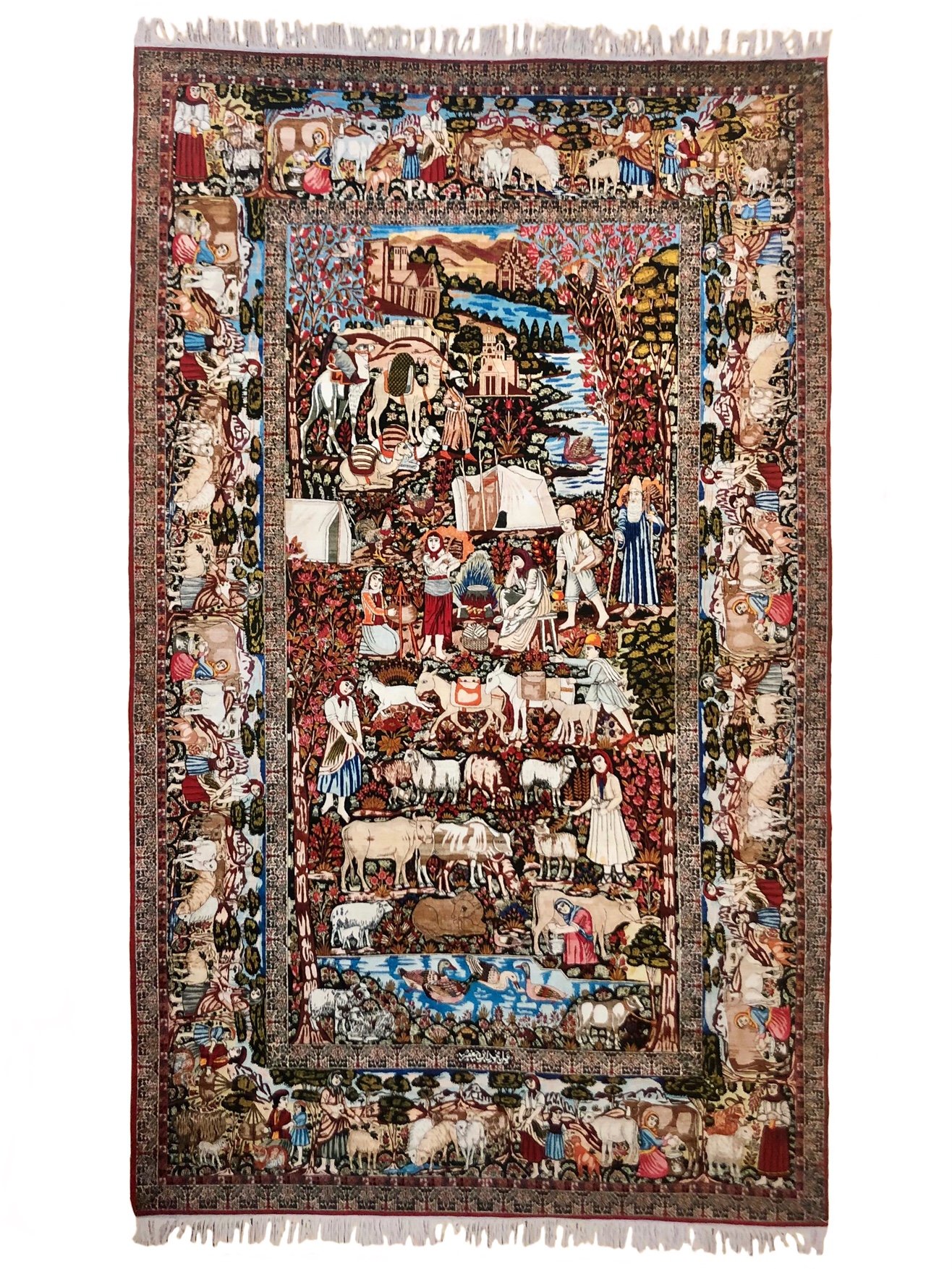
A beautiful live scenaray of life in iran, that shines vividly with natural dyes
Mohammad Arjmand Kermani
Mohammad Arjmand Kermani, famously known as "Sultan Ghali", was a key figure in the Kerman carpet industry from the late Qajar to the Pahlavi era.
Born in 1893, he began learning carpet design as a young child.
He trained under masters such as:
Hassan Khan Shahrokhi
Zaman Khan Mir Hosseini
At the age of 30, he adopted the name Arjmand Kermani, symbolizing his growing reputation.
His carpets gained global recognition, with commissions for:
Buckingham Palace
The White House
Beyond weaving, he was a philanthropist and founded a hospital in Kerman that still bears his name.
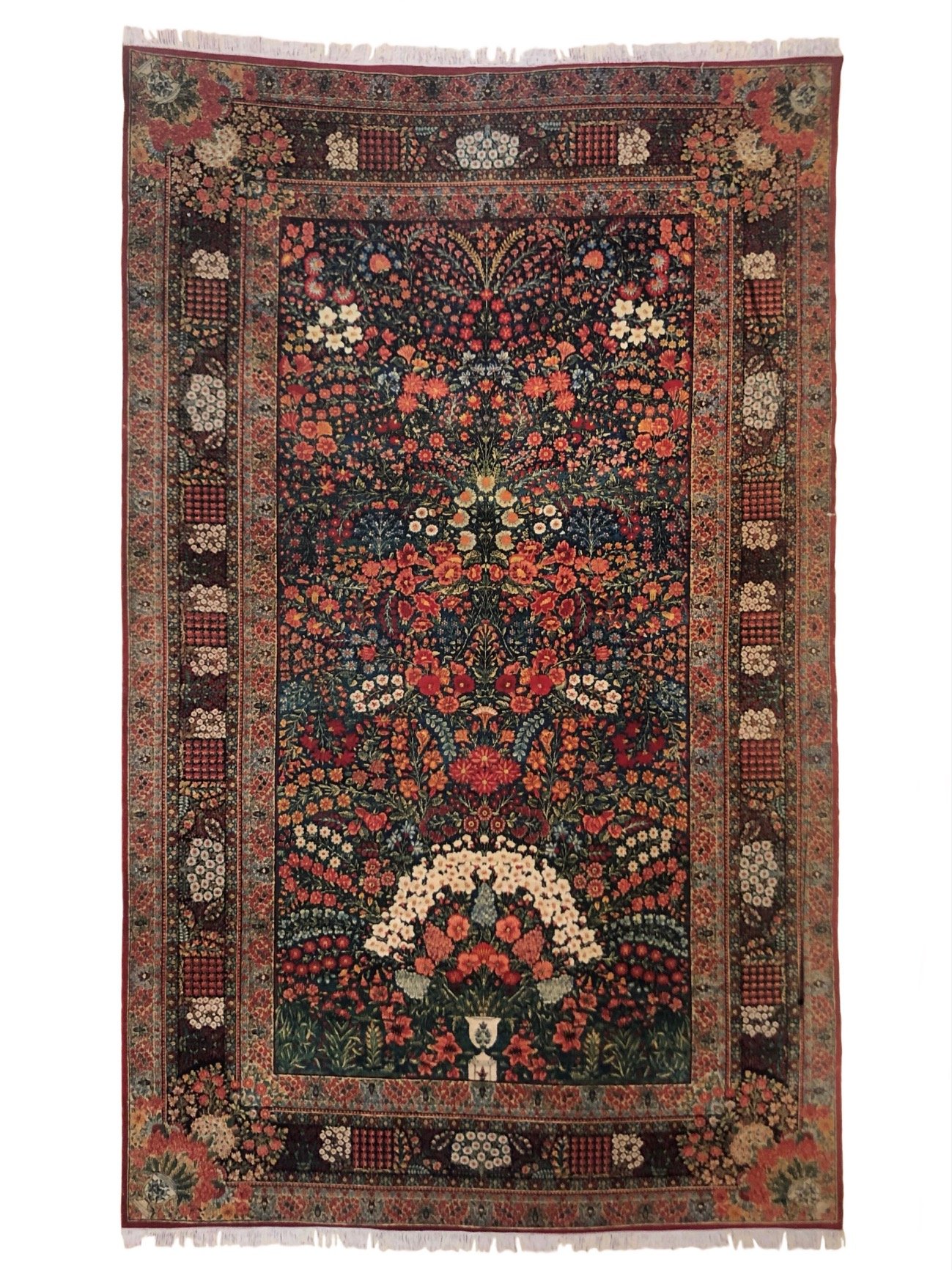
An execution like no other of the millifluer design, by arjmand can you count the 1001 flowers ?
The Shahrokhi Family
The Shahrokhi family is a renowned artistic dynasty in Kerman.
Key figures include:
Ahmad Khan Shahrokhi
Mohsen Khan Shahrokhi
Hassan Khan Shahrokhi
Ahmad Khan Shahrokhi played a pivotal role in shaping Kerman carpet design by blending:
Traditional Persian motifs
New design trends
Their legacy remains a cornerstone of Persian carpet weaving history.

A beautiful carpet designed by Hassan sharokhi and executed by Ali Kermani exhibiting a masterful Millefleur design
Ali Kermani
Ali Kermani, also known as Ali Honari, was born in Kerman in 1877.
He learned the art of Persian carpet weaving under Abolokazem Kermani.
Collaborating with Hasan Khan Shahrokhi, he produced masterpieces known for:
High knot density
Pictorial scenes
Hunting scenes
He continued working until his death in 1939 and remains one of Kerman’s greatest contributors to Persian carpet weaving.
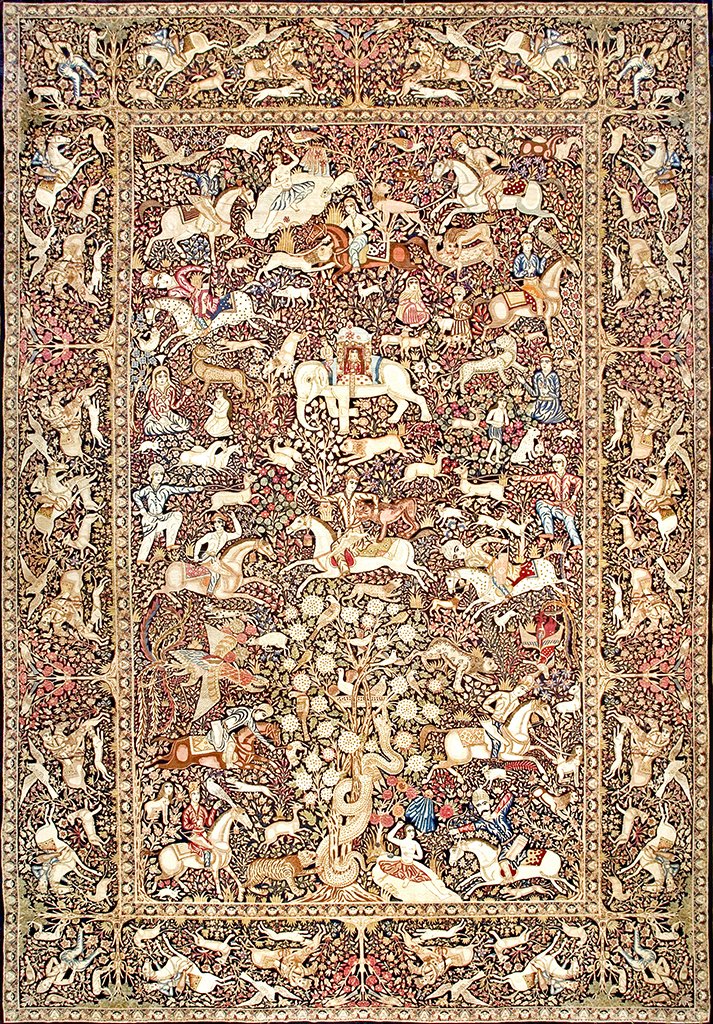
A stunning uni-directional hunting carpet by the grand master ali kermani