
Kashan
Origins
Kashan Persian rugs originate from the city of Kashan, located in the Isfahan province of central Iran. The city has a long and distinguished history of rug weaving dating back several centuries and is renowned for producing some of the finest Persian carpets ever made.
A finely woven Persian Kashan rug is especially admired for its balance of elegance and structure.
Design
Kashan Persian rugs are defined by refined, classical compositions rooted in balance and symmetry.
Common design characteristics include:
Intricate floral motifs
Central medallions
Arabesques
Curvilinear patterns
These designs are typically rendered in rich, saturated colors such as:
Deep blues
Crimson reds
Ivory
Gold
Green
Kashan rugs are celebrated for their elegance, harmony, and disciplined visual structure.
Construction
Kashan rugs are handcrafted using high-quality materials selected for durability and refinement.
Materials and techniques include:
Fine wool, silk, and cotton
Silk highlights are used to accentuate intricate details
Hand-knotting using the Persian knot technique
The result is a dense, durable pile with a soft yet resilient handle.
A true Kashan silk rug often incorporates delicate silk highlights that enhance depth and luminosity.
Size and Shape
Kashan Persian rugs are produced in a wide range of formats, including:
Small accent rugs
Medium decorative carpets
Large room-sized pieces
They are commonly found in:
Rectangular
Square
Oval shapes
This versatility allowed Kashan rugs to adapt to varied architectural and interior needs.
Quality and Collectability
Kashan Persian rugs are among the most highly esteemed of all Persian carpets.
They are valued for:
Exceptional craftsmanship
Artistic refinement
Historical importance
Authentic Kashan rugs are prized by collectors and connoisseurs worldwide and are considered important investment pieces due to their enduring quality and cultural legacy.
An antique Kashan rug, particularly from the late 19th or early 20th century, is especially sought after for its craftsmanship and design precision.
Cultural Significance
Kashan Persian rugs form an integral part of Iran’s cultural heritage. They reflect the region’s history, traditions, and artistic values, representing centuries of accumulated weaving knowledge passed from generation to generation.
As symbols of Persian artistry, Kashan rugs occupy a central place in the story of Oriental carpets.
Evolution
Over time, Kashan Persian rugs evolved while maintaining their classical foundation.
While traditional motifs remained dominant, later examples occasionally introduced:
Innovative color palettes
Abstract design interpretations
Refined reworkings of traditional patterns
This evolution allowed Kashan rugs to remain relevant while preserving their identity.
Overall Significance
Kashan Persian rugs hold a special place in the world of Oriental carpets. They are celebrated for their timeless beauty, meticulous craftsmanship, and cultural importance, continuing to captivate admirers with their enduring elegance.
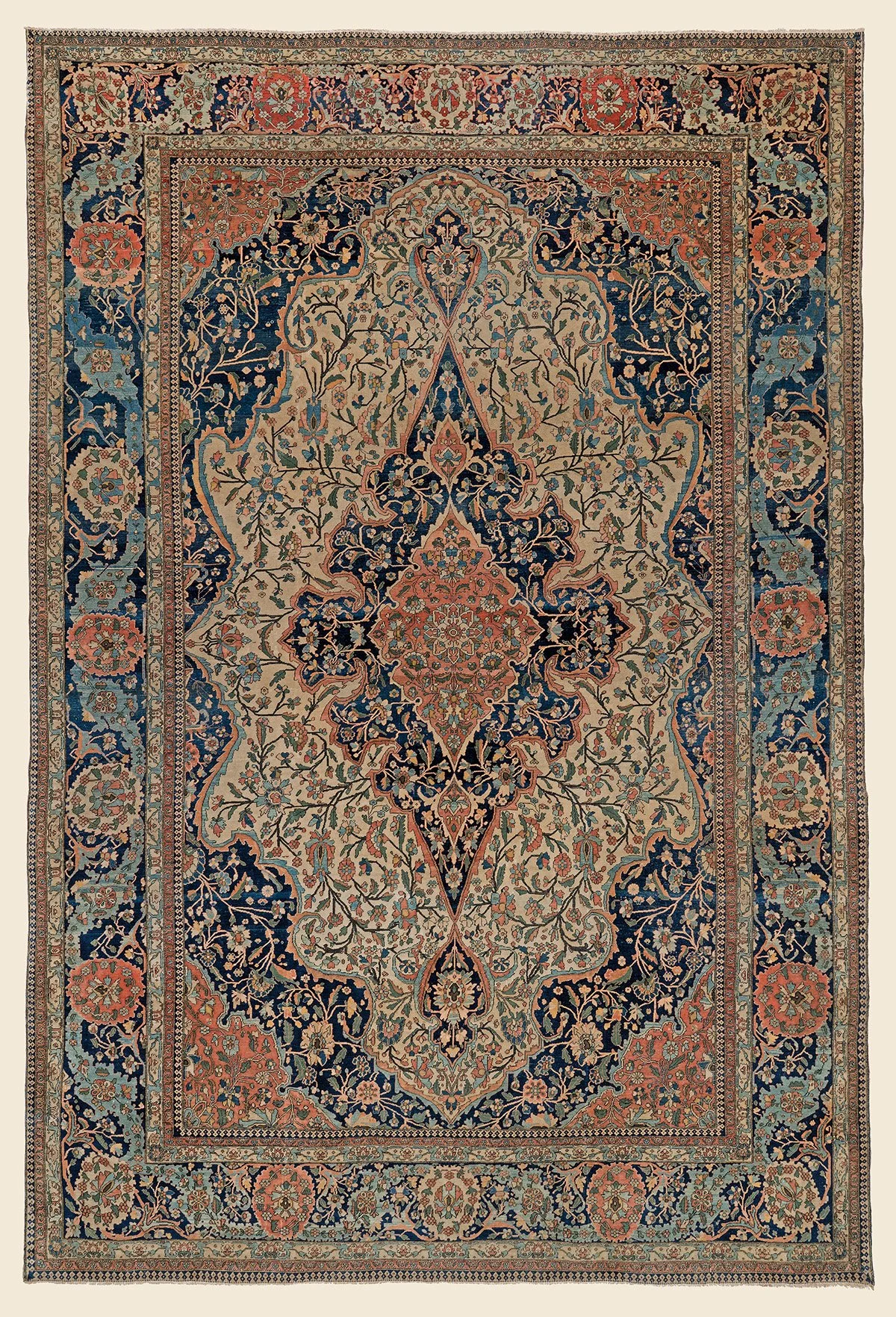
Antique Mohtasham Kashan carpet that is best of type
History
Kashan, a city in the Isfahan province of Iran, experienced a period of remarkable cultural and artistic flourishing during the Safavid period (1501–1722).
This era is widely regarded as a golden age of Persian art and architecture. During this time, Kashan emerged as a major center for:
High-quality ceramics
Textiles, particularly silk
Fine carpet production
Kashan’s workshops gained international recognition, supported by a large community of skilled artisans whose work established the city as a cultural and artistic hub.
Design elements from Safavid-era Kashan carpets, including:
Central and corner medallions
Cloud bands
Peonies
also appeared in other artistic media such as bookbinding and manuscript illumination. These motifs, originally derived from Chinese art, had been fully absorbed into Safavid artistic language by this period.

A Full silk Safavid Kashan carpet owned by the Metropolitan Museum of New York

A Full silk Safavid Kashan carpet owned by the metropolitan museum of New York
Second Revival
During the mid-to-late 19th century and early 20th century, the Mohtasham workshop produced carpets that astonished the market with their extraordinary execution. As a descendant of a revered Safavid-era Persian poet, Mohtasham helped firmly establish Kashan as a leading rug-weaving center.
Hajji Mullah Mohammad Hassan Mohtasham
Mohtasham Kashan carpets are regarded as some of the most extraordinary works in Persian carpet history.
Hajji Mullah Mohammad Hassan Mohtasham operated the most famous workshop of his time and was also active as a wool merchant. In the 1890s, he married a woman from Arak. When the clothing market collapsed, it is said that his wife repurposed merino wool to produce carpets displaying Sarouk-style characteristics, with knot counts often ranging between 200 and 400 knots per square inch.
This moment marked the beginning of the Mohtasham legacy as it is known today.
Scholars believe that certain unsigned Kashan carpets were directly supervised by Mohtasham himself due to their use of identical dyes found in signed Mohtasham silk pieces.
At the onset of the Great Depression, weavers transitioned from imported wool to local materials. However, the availability of machine-spun Merino wool from Manchester, England, allowed:
Higher knot counts
Crisp, well-defined motifs
Lustrous carpets with a high pile
A finely woven Kashan carpet of this era was referred to as a “Mohtasham school” carpet if it exhibited:
High knot density
Velvety handle
Superb execution
Soft merino wool
Only a small number of signed Mohtasham pieces survive today. These serve as benchmarks for historians and collectors when identifying authentic workshop productions versus attributed examples.
During the mid-to-late 19th century and early 20th century, the Mohtasham workshop produced carpets that astonished the market with their extraordinary execution. As a descendant of a revered Safavid-era Persian poet, Mohtasham helped firmly establish Kashan as a leading rug-weaving center.

A breath taking Mohtasham kashan that is very well executed
Ateshglou
(Mirza Ali Akbar Khan Natanzi)
During the Qajar period, Mirza Ali Akbar Khan Natanzi, also known as Mazin al-Dawlah or Ateshglou, emerged as a singular figure bridging painting and carpet weaving.
A graduate of the Paris School of Fine Arts, he introduced European academic painting techniques to Iran and taught at Dar al-Fonun, influencing artists such as Kamal al-Mulk.
In carpet weaving, Ateshglou began his career in the Mohtasham workshop before establishing his own studio. While Mohtasham favored lighter palettes, pastels and oranges, Ateshglou embraced darker tones that gained popularity in the early 1900s.
His carpets frequently featured:
Zoomorphic imagery
The Vaq Vaq tree (symbolizing good and evil)
The Tree of Life
Mythological and philosophical narratives
Although the Mohtasham workshop ceased production around 1918, Ateshglou continued working well into the 20th century, ensuring his legacy endured as both a pioneering painter and master carpet weaver of the Qajar era.

A stunning atesghlou kashan executed almost 100 years ago
Dabir Sanai
Mohammad Farshchi, known as Mohammad Dabir Sanai, was one of the most celebrated Kashan carpet artists of the early 20th century.
Born into a merchant family, he was deeply influenced by his father, Taghi Kashani, who commissioned works from Mohtasham and collaborated with Tehran painter Reza Hosseini. Raised in this artistic environment, Dabir developed a strong fascination with carpet design from a young age.
His early works were admired for their elegance and creativity, earning him the name Dabir Sanai, meaning “teacher of crafts.”
Dabir became known for:
Selecting the finest wool and dyes
Producing carpets with exceptional weave density
Advancing Kashan weaving beyond earlier generations
He was the first to introduce Haji Hanumi, Mina Hani, and Jir Haki patterns into Kashan carpets. Over time, he transitioned from design to full production, becoming the most renowned Kashan carpet artist of the Pahlavi dynasty.
It is believed he passed away around 1979, after which his workshop closed. Despite limited records of his later years, his influence remains foundational in Kashan carpet history.

A master piece from the dabir sanei workshop
tradition
Tafazoli (or Tafazzoli) was a renowned master weaver based in Kashan, recognized for his exquisite craftsmanship and intricate designs during the late 19th and early 20th centuries.
His workshop specialized in producing high-quality silk carpets, celebrated for their refined artistry, often featuring detailed floral motifs and elaborate medallions.
Key Features:
Materials: Luxurious silk used as the primary material, giving the rugs a luminous sheen and smooth texture.
Craftsmanship: Known for producing soft rugs with raised silk designs on a flat-weave base, demonstrating the innovation and technical expertise of Tafazoli’s weavers.
Tafazoli’s carpets are celebrated for their balance between:
Luxurious materials
Meticulous craftsmanship
Due to the rarity and exceptional quality, Tafazoli carpets are highly sought after by collectors.
Many surviving examples are considered museum-quality Kashan silk rugs.

A Taffazoli kashan with incredible multiple medallions using intelligent placement of islimis
Atayi
The Atayi family of Kashan produced some of the most refined Persian carpets during the late 19th and early 20th centuries.
Their carpets are distinguished by:
Hand-knotted craftsmanship
High-quality wool
Elegant, disciplined design
Common features include central medallions surrounded by intricate floral or geometric patterns, deeply rooted in Kashan tradition.
Atayi carpets are especially noted for bold yet harmonious color palettes, often dominated by:
Red
Blue
Ivory
Renowned for durability and meticulous construction, Atayi rugs remain highly sought after in the antique market.
Exceptional pieces are often described as important examples of the antique Kashan rug tradition.
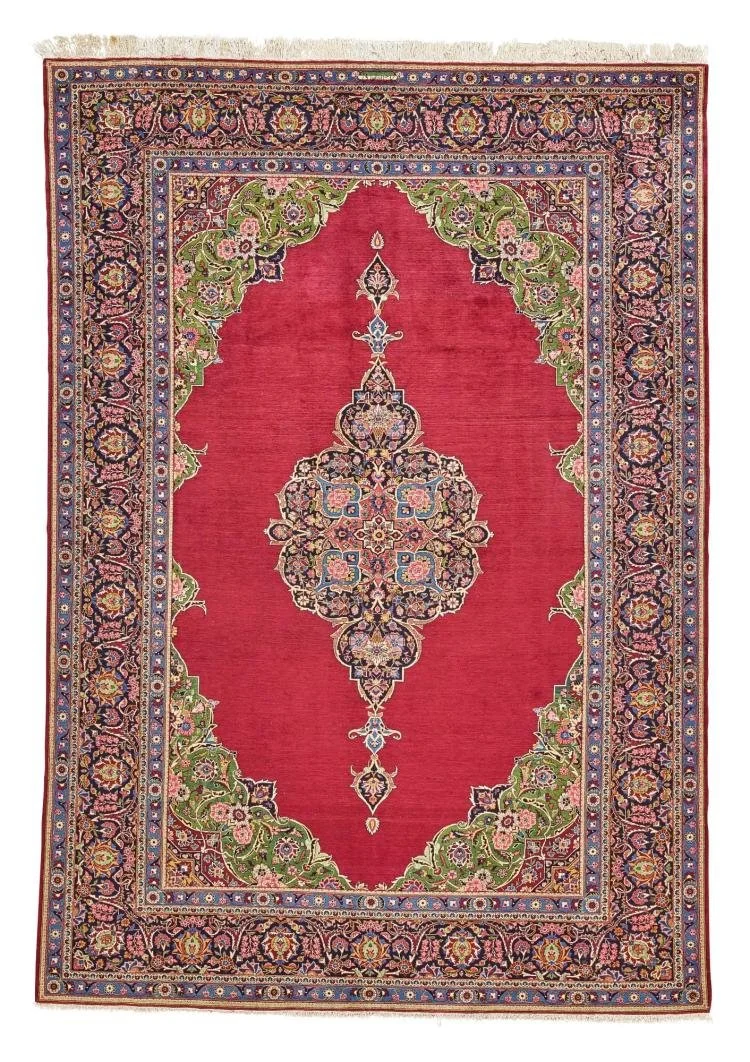
A simple yet elegent atayi kashan that is grounded in neutral colors